This work has been conducted as an internship at the EPFL AI Center and was supervised by Xiaozhe Yao, Systems Group, ETHZ.
Inference engines such as vLLM and SGLang must go through several steps before they can serve requests (e.g., importing dependencies, loading model weights, capturing CUDA graphs, etc.). This creates a significant cold-start latency. On the SwissAI serving platform, we observed that most of this time is spent loading model weights from a Lustre datastore into GPU memory.
In this post, we focus on weight loading from HDD-backed Lustre storage. We show how we reduced the weight-loading time for GLM-4.7 from ~827 seconds to ~16 seconds (51× faster). The resulting approach is packaged in a small wrapper called servekit.
I. Time Breakdown
Let’s first map the cold start steps to their wall-clock time to identify the bottlenecks. We can do this by parsing the logs printed by the SGLang server during the cold start phase. We added the log parser to servekit as a CLI command: servekit profile.
For this experiment, we use Llama-3.1-70B-Instruct served with SGLang v0.5.10 (image lmsysorg/sglang:v0.5.10) with tensor-parallel size 4 on a single Bristen cluster node, with weights loaded with the default sglang model loader. SML keeps models in capstor/store, which is a Lustre file system backed by HDDs.
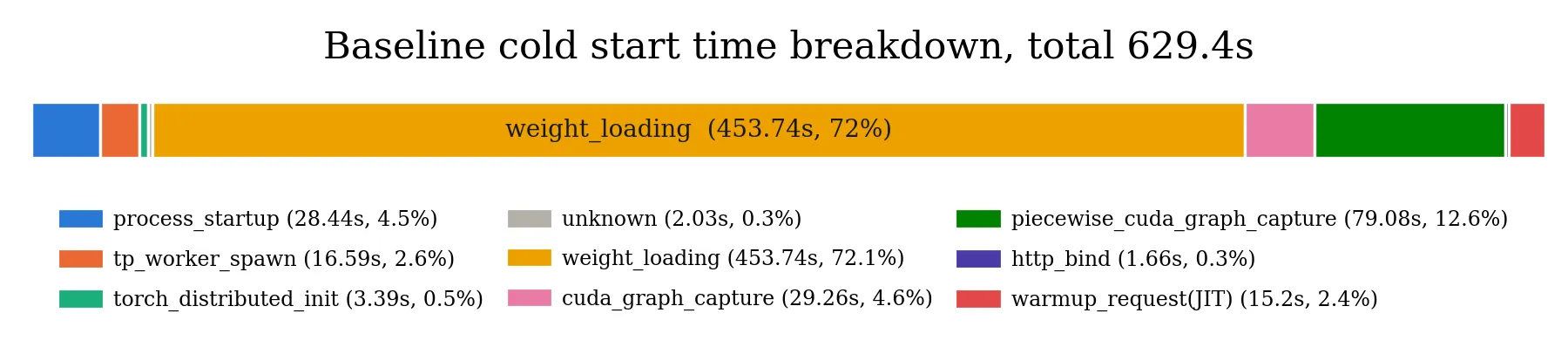
These breakdowns are highly variable: they depend on capstor contention, per-node differences, and other factors. This document compiles 3 runs of the baseline breakdown on different days with per-phase statistics (mean, stddev, min, max).
As we can see, loading weights from persistent storage (capstor/store) is by far the most time-consuming step, with 72% of the total cold start time. It is followed by CUDA graphs capture (piecewise_cuda_graph_capture + cuda_graph_capture) which is 17%. The other steps account for around 11% of the total cold start time and are mostly JIT compilation and Python package imports.
II. Weight Loading
Weight loading is clearly the bottleneck. 453.74 seconds for a 70B (141 GB) model is a lot: that is only 0.29 GiB/s. Capstor’s aggregate theoretical bandwidth (across all users and jobs) is a whopping 1.19 TB/s, and we are connected to it with 4 HPE Cray Slingshot-11 NICs with a combined bandwidth of 4 x 23.28 GiB/s, so that NIC bandwidth should be our bottleneck. We should be able to do much better than 0.29 GiB/s.
This raises the obvious question:
Why is the default weight loader so slow in our setup?
1. The default weight loader and mmap
The default SGLang loader uses mmap to load the weight files.
But what is mmap? mmap is a system call that maps a virtual memory region to a file. That memory region will not be mapped to a physical memory region until it is accessed a first time. When a mmaped page is accessed for the first time, the kernel will realize that the virtual page does not have a corresponding physical page but is mmaped to a file. So it will load the corresponding page from disk to the page cache (RAM) and then associate the virtual page with the page cache page. This is called a major page fault. On subsequent access, the virtual page is already mapped to a physical page in the page cache and no disk access is needed. This is called a minor page fault [1].
Concretely, in our Llama example, the DefaultModelLoader calls methods like multi_thread_safetensors_weights_iterator, which return an iterator over pairs (tensor_name, tensor_weights) where tensor_weights is an mmap’ed tensor. This iterator is passed to LlamaForCausalLM, which passes each parameter (like ColumnParallelLinear) its tensor weights. The parameter will then get a view of its needed weights according to its rank (tp_rank in the case of ColumnParallelLinear) and will then initiate a host (CPU) to device (GPU) copy of the weights.
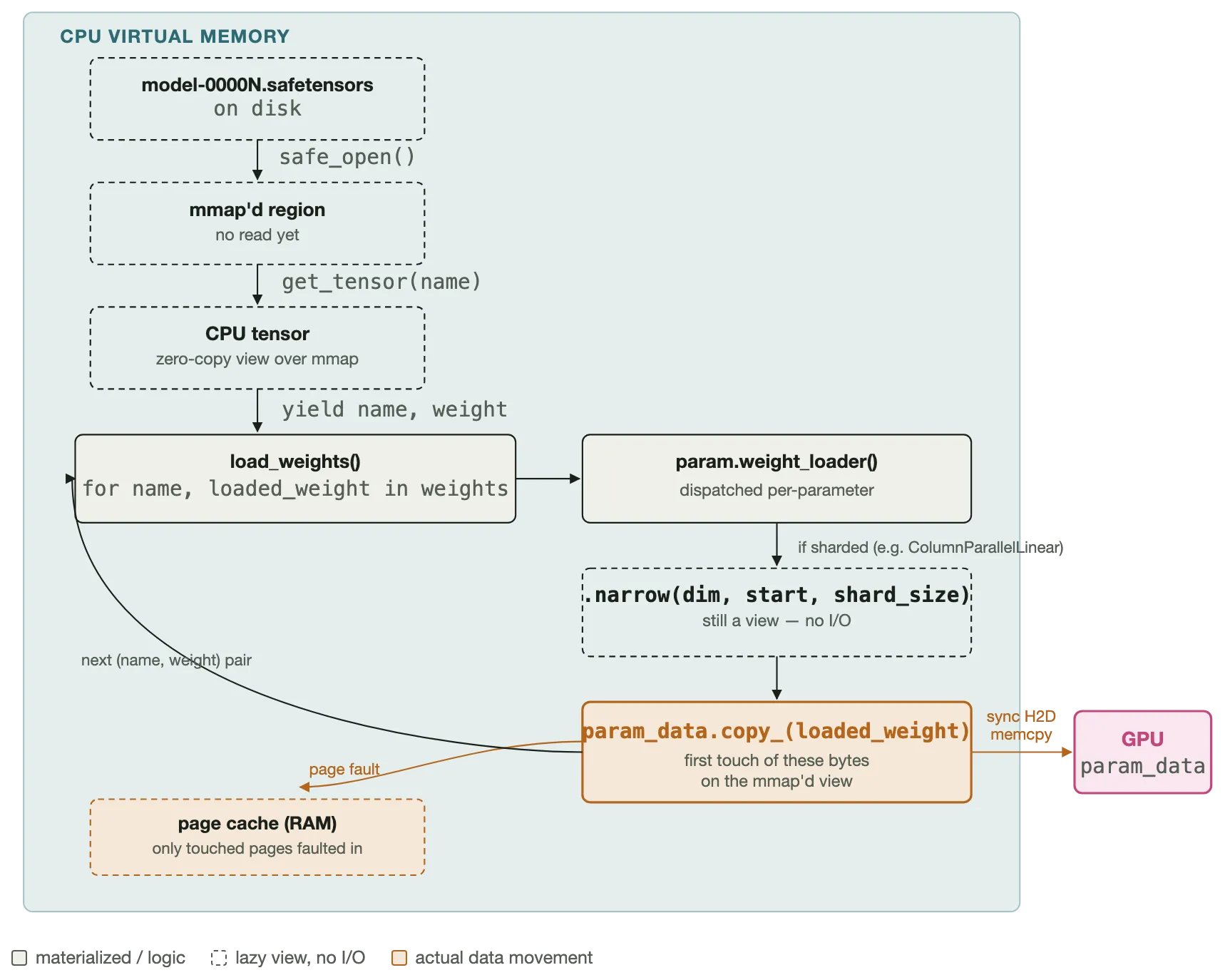
Our hypothesis is that this triggers a major page fault for each page touched, which gets loaded from Lustre going through the network to the page cache and then copied to GPU. This would be a very slow process, especially for large models with many tensors spread over many pages [2].
To check this, we run the exact same experiment with SGLang’s --weight-loader-disable-mmap, which skips mmap entirely.
We get 45.7s for weight loading, which is 9.9x faster than the default loader and corresponds to 2.8GiB/s.
Lesson. For weight loading using an HDD-backed Lustre file system, using
mmapis a bad idea. The simple--weight-loader-disable-mmapflag is a huge improvement.
This still leaves another possible explanation: maybe it’s not mmap itself but the many small host-to-device copies it causes. Let’s try another one-flag method that does not use mmap: fastsafetensors [3] (--load-format fastsafetensors) partitions files across TP ranks; each TP process reads a file with pread and then exchanges the weights with other TP ranks using NCCL communication. Once all weights are on each GPU, tensors are parsed one by one directly in GPU memory. This eliminates the need for small tensor copies from host to device. If the small copies were the real bottleneck, this should beat --weight-loader-disable-mmap.
We get 59.1s for weight loading, which is 7.7x faster than the default loader but worse than --weight-loader-disable-mmap. This confirms again that the bottleneck was mmap and not the small tensor copies from host to device.
This is a huge improvement and shows that mmap is not suitable for weight loading on Lustre file systems. However, 2.8GiB/s is still far from the theoretical maximum of 4x23.28 GiB/s. Let’s see if we can do better.
2. Understanding the lustre data storage
Let’s set SGLang aside for a moment and ask a simpler question:
Irrespective of SGLang, how fast can we load files from Lustre?
Across OST parallelism. Lustre is a distributed file system that saves files across different Object Storage Targets (OSTs). Each OST is a storage volume that can be accessed independently. To increase the read bandwidth, we need to distribute the model weights across multiple OSTs so we can benefit from parallelism across OSTs. In our case, we will have each .safetensors file in a different OST. For models like Llama-3.1-70B-Instruct, there are 30 .safetensors files.
However, single OSTs also benefit from having many requests in flight.
Within OST parallelism. Even within a single OST, we can increase the read bandwidth by having multiple processes reading from the same OST in parallel. This is because each process can issue its own I/O requests, and the OST can handle these requests concurrently.
How many parallel readers does a single OST need to reach its full read bandwidth?
To answer this, we will experiment with dd iflag=direct. This command lets us read files from disk without going through the page cache. We can use it as follows: dd iflag=direct if=input.bin of=output.bin bs=16M, where bs=16M is the block size, i.e. the amount of data read from disk in one request. In our experiment, we use bs=16M and read to /dev/null to measure the read speed. We study the effect of the number of parallel dd processes on the read speed.
per=$(( 256 / nprocess ))
t0=$(date +%s.%N)
for ((i=0;i<nprocess;i++)); do
  dd if="${SICK}" of=/dev/null bs=16M skip=$((i*per)) count=$per iflag=direct status=none &
done
We measure this on a single-striped 4.6 GB shard, reading a 4 GiB window of it (bs=16M, O_DIRECT, to /dev/null) while sweeping the number of parallel dd processes over disjoint, contiguous byte ranges of the same file. Each point is the median of 3 runs; bars span min to max:
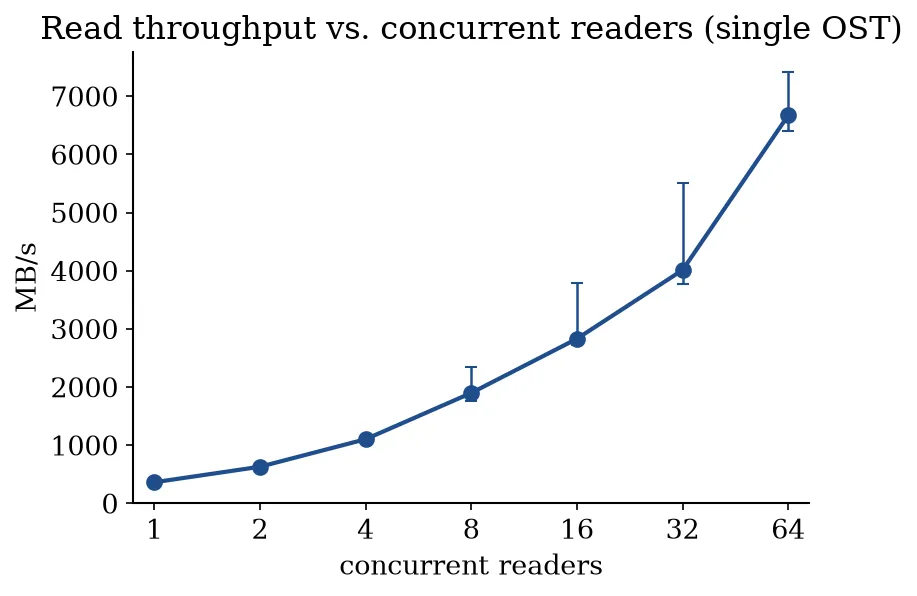
Throughput scales close to linearly with reader count up to 8, then keeps climbing sublinearly: 64 readers reach 6.7 GB/s, an 18x speedup over a single reader, and the curve has still not flattened. With many processes, we are able to keep many RPCs in flight, improving the bandwidth.
Lesson. To maximize bandwidth on Lustre storage with
O_DIRECTreads (no page cache), we need parallelism both across OSTs and within a single OST.
Equipped with this knowledge, we try the following:
- Load in parallel (60 processes per file, which is maybe too much) from Lustre to
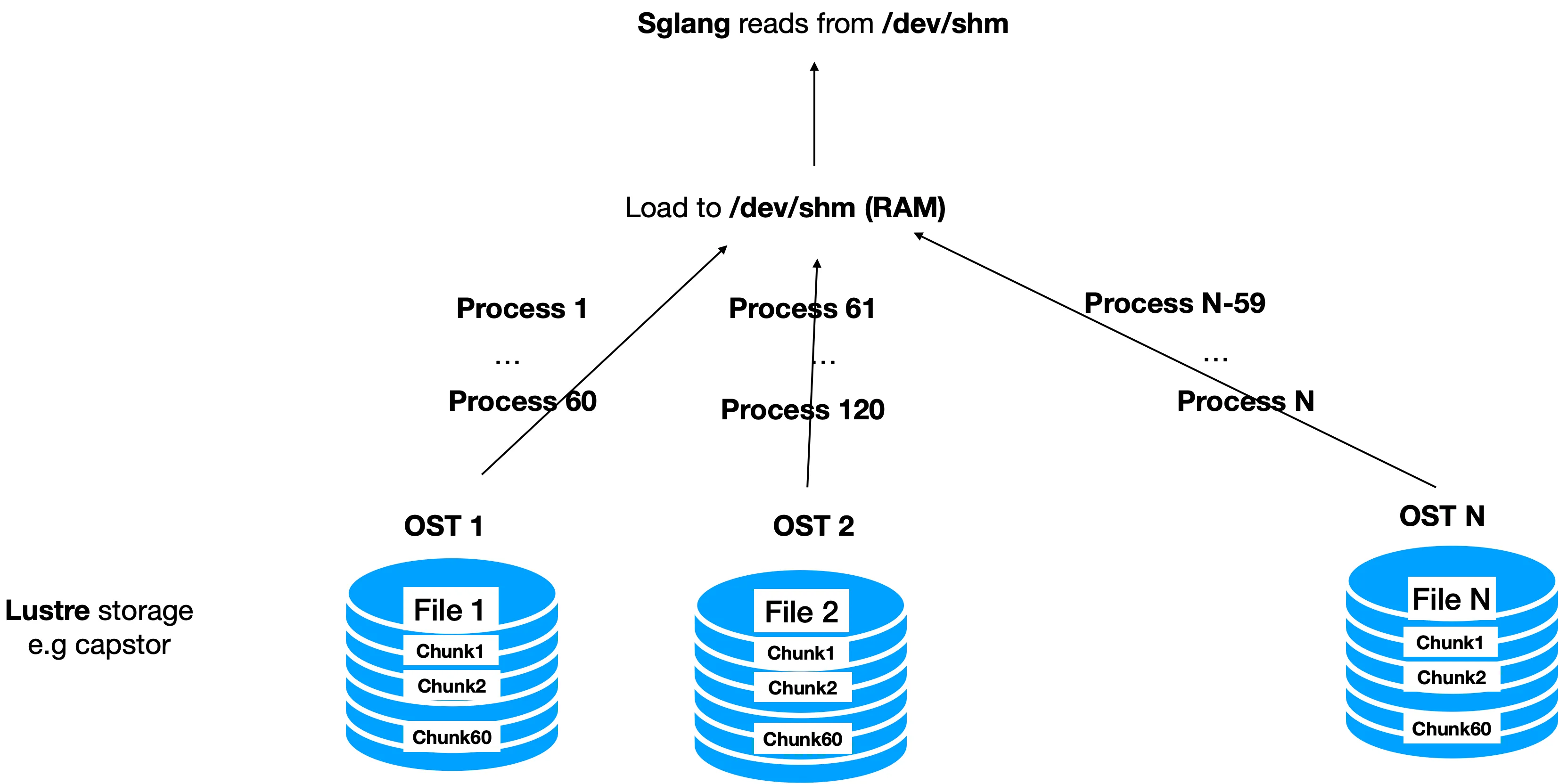
/dev/shm(RAM), and then use SGLang’s default loader from/dev/shmto GPU. The staging takes7s, which is more than 18 GiB/s, already much better than everything we have seen before. The weight loading takes20s, which is> 6 GiB/s. Overall, this is a 16x speedup over the default loader.
-
This idea is possible because each node in both our clusters (Bristen and Clariden) has more RAM than GPU RAM. This means a node’s specific shard of weights can always be stored in RAM if we preshard the weights across nodes. This is what we do next. We use
--load-format sharded_state, which lets us save our weights by their TP rank. One added benefit is that our weights are now contiguous for each rank, which speeds up our H2D reads (see below). -
Additionally, we can overlap the staging with the SGLang server launch. This is possible because the first steps (
process_startup,tp_worker_spawn,torch_distributed_init) do not need the weights. We can start staging to/dev/shmwhile the server is still inprocess_startup. This is what we report below as /dev/shm staging + presharded + overlap. -
Staging to
/dev/shmis better than warming up the page cache for models that don’t fit in a single node. For these, to warm all the weights a rank needs, we would need to fill the page cache with all weights of the model which don’t fit in the RAM. -
Staging to
/dev/shmis different from using--weight-loader-disable-mmapin two ways.- Scaling: With
--weight-loader-disable-mmap, each rank still reads the complete model weights: although it discards most of it and keeps only its shard, it still reads all of it. This means the total size of weights loaded increases linearly with the node count. In our method, it remains constant. - Implementation: the standard
--weight-loader-disable-mmaphas 8 threads by default, each running apreadon a file. If our files are big, this will overflow RAM.
- Scaling: With
Weight loading experiments (s), Bristen
| config | weight_loading (s) | speedup | total cold start (s) |
|---|---|---|---|
| default loader | 453.7 | 1.0× | 629.8 |
| nommap | 45.7 | 9.9× | 214.7 |
| fastsafetensors | 59.1 | 7.7× | 230.0 |
| /dev/shm staging + mmap | 20.1 + 7.7 (stage) | 16.3× | 194.7 |
| /dev/shm + TP-presharded | 8.8 + 7.4 (stage) | 28.0× | 170.8 |
| /dev/shm staging + presharded + overlap | 9.7 | 47.0× | 179.0 |
- To avoid corrupting our results with any kind of caching, we run the methods in reverse order of expected speed and on different nodes, meaning
/dev/shm + presharded + overlapran before the default loader experiment. - Similarly to the previous section, these results are highly variable, so we provide 3 runs of each experiment (conducted on different days) in this document with statistics (mean, stddev, min, max).
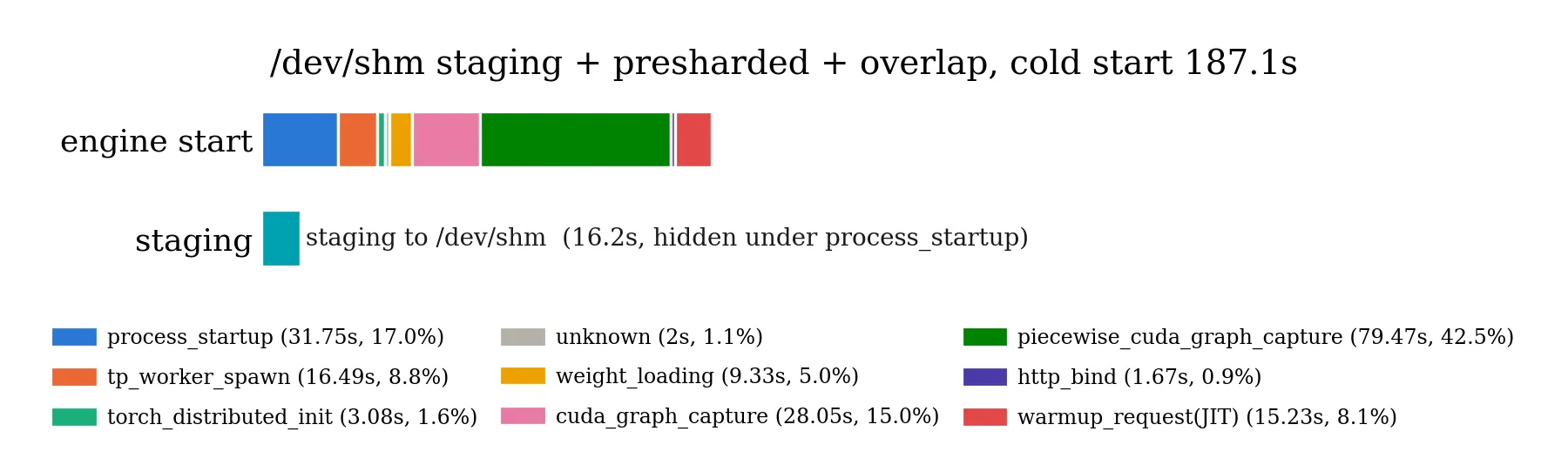
Here’s the current breakdown of the cold start of our best method, /dev/shm staging + presharded + overlap. The weight loading is not the bottleneck anymore, the cuda graph capture is.
3. Fast weight loading with servekit
We packaged the above ideas into a small wrapper called servekit that can be used to launch SGLang servers with fast cold starts. It is not a new serving engine: it simply stages and launches SGLang with the optimizations described above. Currently, servekit implements fast weight loading and JIT kernel caching (the latter is outside the scope of this post).
servekit has a main command, servekit launch, which takes a normal SGLang command as an argument and launches it with optimizations.
servekit launch --servekit-artifact-path <dir> \
  -- python -m sglang.launch_server --model-path <model> --tensor-parallel-size 4 ...
servekit also offers several utilities, such as servekit profile, servekit bench and servekit verify, to profile a cold start, benchmark a running server, and verify that the server produces the same numbers as a trusted reference. You can find documentation for these commands in the servekit README.
Comprehensive results
We evaluate servekit against the default loader, --weight-loader-disable-mmap and --load-format fastsafetensors on multiple models.
Config
| Apertus-8B-Instruct-2509 | Llama-3.1-70B-Instruct | GLM-4.7 | |
|---|---|---|---|
| size | 16 GB | 141 GB | 717 GB |
| parallelism | TP4 | TP4 | TP4-PP4 |
This sweep uses SGLang v0.5.16 (image lmsysorg/sglang:v0.5.16).
Weight loading time (s) on Bristen
| Loader | Apertus-8B-Instruct-2509 | Llama-3.1-70B-Instruct | GLM-4.7 |
|---|---|---|---|
| default loader (mmap) | 78.0 | 737.0 | 827.9 |
--weight-loader-disable-mmap | 9.5 | 46.0 | 294.9 (num_threads=4) |
--load-format fastsafetensors | 17.9 | 61.3 | 143.8 |
| servekit (shm, no overlap) | 3.3 + 2.0 | 9.3 + 14.2 | 10.6 + 16.4 |
| servekit (shm, overlap) | 2.1 | 14.3 | 16.2 |
Weight loading time (s) on Clariden
| Loader | Apertus-8B-Instruct-2509 | Llama-3.1-70B-Instruct | GLM-4.7 |
|---|---|---|---|
| default loader (mmap) | 92.8 | 794.2 | 861.6 |
--weight-loader-disable-mmap | 4.5 | 27.8 (num_threads=4) | 263.7 (num_threads=2) |
--load-format fastsafetensors | 11.9 | 48.6 | 113.8 |
| servekit (shm, no overlap) | 1.1 + 0.9 | 5.1 + 6.0 | 40.8 + 6.5 |
| servekit (shm, overlap) | 0.9 | 6.0 | 6.7 |
--weight-loader-disable-mmapOOMs on GLM-4.7, so we had to reduce the number of threads to 4 on Bristen and 2 on Clariden. Similarly, it OOMs on Llama-3.1-70B-Instruct on Clariden, so we had to reduce the number of threads to 4.fastsafetensorsdoes not work for multi-node currently; the reported result for GLM-4.7 is a patched version.
Lesson. The one-flag loaders read the full model on every rank, so load time grows with node count.
servekitstages only each node’s shard, so it stays roughly constant: GLM-4.7 (717 GB) loads about as fast as Llama-70B (141 GB), ~16s vs. ~14s.
servekit’s limitations
-
On Correctness:
servekitrelies onShardedStateLoader, the loader behind--load-format sharded_state, which we discovered contained some bugs. To spot bugs, we useservekit verify --url <ip> -record gold.jsonto record the gold logprobs of a model served with the default loader, and then useservekit verify --url <ip> -compare gold.jsonto compare the logprobs of the same model served withservekit. This is a very strict test that checks that the logprobs are equal up to1e-6. All models above pass this test. However, some models currently don’t, because of bugs inShardedStateLoader(e.g.gpt-oss-20b). It is therefore important, when usingservekit, to first check that your model is supported withservekit verify. See this sbatch script for an example of how we useservekit verifyto check a model (GLM-5.1-FP8, multinode, TP4/PP4/EP4) against a baseline before trusting the presharded loader for it.We discovered and reported two bugs in
ShardedStateLoaderto the SGLang team: #34448 (mxfp4 weights are silently dropped, relevant for Kimi-K3) and #35702 (sharded_statecannot load MLA models, relevant for GLM-5.x;servekitcurrently patches this one, but that is not a permanent solution). The corresponding fixes are in PRs #35715 and #34558, respectively. -
On ergonomics: Presharding the models implies a separate prepare step;
servekittries to simplify this by doing it automatically on the first run, so users don’t need to worry about it. When runningservekit launch --servekit-artifact-path <path> python -m sglang.launch_server ..., a presharded copy of the model is created in<path>. This causes a first run to be slower than the default loader.
servekit vs. the other loaders
| Method | Pros ✅ | Cons ❌ |
|---|---|---|
| default loader (mmap) | Really slow on Lustre | |
--weight-loader-disable-mmap | One flag, 2.8x to 16x faster than default | - OOMs on large models (GLM-4.7), needed num_threads=4 to fit- Loads all weights per rank so scales badly with model size - Needs a full node: 3.9x slower at 32 CPUs than at 128 |
--load-format fastsafetensors | - One flag, significant speedups | - Doesn’t work for multi-node yet; GLM-4.7 result needed a patched version - Scales badly with node count due to costly NCCL through Slingshot |
| servekit | - Fastest across all models - If model size scales linearly with node count, weight size loaded per node is constant and so is time (see Llama vs. GLM-4.7, 14s vs. 16s) | - Slower first run - Relies on ShardedStateLoader, a correctness check is needed |
Conclusion
We hope this post is useful if you are facing slow weight-loading times on HDD-backed Lustre storage. The approach described here is packaged in servekit and can be used as a drop-in wrapper around SGLang.
If you would like to try servekit, feel free to open an issue on the servekit repository. We will be happy to help you get started.
There are also several directions to be explored to extend this work, including support for vLLM and additional SGLang model architectures.
References
[1] A threadpool of size 8 is used to do mmap in parallel.
[2] Actually, when a page fault happens a certain number X of pages is loaded at once for efficiency, thanks to readahead. This X is set by the Lustre client. However, even with this in mind, the general intuition that this causes many small network round trips remains.
[3] Speeding up Model Loading with fastsafetensors. https://arxiv.org/abs/2505.23072 (GitHub)